According to Business Insider (yes… I know), Meta is updating their performance distribution. Whatever your opinions about performance ratings, distributions, stacked rankings, etc., I hear you. Still, I was curious what the impact would be on employees, ignoring all the marketing-speak from company leaders. A quick haiku to summarize:
My TL;DR?
    It looks like this adjustment
        Was a good idea
What’s changing?
Meta is shifting to having only 4 ratings, (Outstanding, Excellent, Needs Improvement, Not Meeting Expectations) but really there is a 5th rating (the Meta Award) and in practice the bottom two ratings can be lumped together, so it’s up to you whether you think there are 3, 4, or 5 ratings here.
Notably, a whopping 70% will be considered Excellent, effectively combining the Average and Above Average groups that most performance plans have (with various names).
Distribution Detail
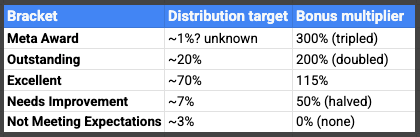
Because I worked at Meta I have a decent idea of what specifically changed here. Without getting into details, I can share my best guess at who benefits, and who is losing out.
For the sake of this microanalysis, let’s assume/pretend performance ratings measure performance accurately.
Who benefits?
Strong performers: people near the top (but not at the top) of the performance curve should see the biggest increases to their bonus multiplier.
Anyone involved in calibrating performance. Even assuming the best intentions all around, there will be uncertainty about an employee’s relative performance. They’re good, but are they Above Average? …or Very Above Average?
Moving to fewer ratings means fewer cut points, or fewer boundaries where the uncertainty actually matters. If the employee is clearly above one rating boundary (say, Needs Improvement/Excellent), and clearly below another (Excellent/Outstanding), there isn’t any specific need to figure out exactly where they fall between those bars.
In the new system, there are only two really significant cut points: deciding if an employees should receive Needs Improvement or Excellent and if an employee should receive Excellent or Outstanding. Most performance systems have at least three cutoffs (Below Average / Average / Above Average / Very Above Average) and some have even more. Getting it down to two should save managers a lot of time and angst.
Below average, but solid, performers. People just above that Excellent cutoff point are definitely winning here. Now that 70% of the company is Excellent, nobody is getting a straight bonus — so people who used to get an Average rating are getting a 15% bonus increase. That’s not huge, but it’s not bad!
Who loses out?
The very very top performers appear to have a slightly lower bonus ceiling in this new system, but I suspect they’ll be ok.
So, is it good?
Based on what changed, it appears that Meta made these changes in an effort to:
better reward strong performers
reduce manager effort
improve sentiment of Average rating recipients
I think those are useful things to improve, and if those were Meta’s goals, these changes should help.